Quick Summary:
HYGEN microfibre mop pads withstand up to 500 commercial washes and 200 bleach laundering cycles per CDC guidelines
Proven to remove 99.9% of tested viruses and bacteria with water alone, maintaining efficacy across the full pad lifecycle
Facilities report a 17% reduction in daily cleans and a 27% reduction in terminal cleans using HYGEN mopping systems
Premium 16-split nylon/polyester blend construction outperforms cotton and standard microfibre in durability and cleaning performance
Reduces water and chemical consumption by up to 95%, lowering replacement waste and total cost of ownership
Every facility manager knows the routine. Mop pads go through dozens of laundering cycles, and over time, the fibres start to wear. Performance shifts. Replacement orders go in sooner than expected. Waste adds up, and so do the labour hours spent managing stock and swapping out pads mid-shift.
It is a familiar cycle across commercial and healthcare facilities. And it raises a practical question: what if the mop pad itself were built to last longer, clean better, and withstand the rigours of hot-water and bleach laundering from day one?
That is exactly where durability becomes a procurement decision, not just a product spec. The right microfibre mop pad should maintain its cleaning performance across hundreds of washes, reduce replacement frequency, and lower the total cost of each clean. When durability is built into the product, everything downstream becomes easier: less waste, fewer interruptions, and more consistent infection-prevention outcomes.
Most standard microfibre mop pads are not designed to survive the demands of commercial cleaning. After a few dozen machine washes, the fibres begin to degrade. The mop loses its ability to lift dirt, dust, and stains from floor surfaces. It stops picking up the microscopic particles that matter most in healthcare facilities and other high-risk environments.
The result is a constant replacement cycle. Facilities burn through mop pads at a rate that inflates material costs and generates unnecessary waste. Staff spend time managing inventory and swapping out worn pads, rather than focusing on efficient cleaning workflows. Cotton mops and low-grade microfibre simply cannot keep pace with the demands of commercial environments.
When mop pads fail after 50 or 100 washes, the true cost is not just the replacement. It is the decline in cleaning efficacy that occurs well before the pad is discarded.
Rubbermaid Commercial designed the HYGEN microfibre range from the ground up for commercial durability. Every element of the mop pad construction is engineered to withstand repeated machine laundering at high temperatures without losing cleaning performance.
The headline figure speaks for itself: one HYGEN microfibre mop pad lasts up to 500 commercial machine washes. That includes up to 200 washes with bleach, following CDC laundering guidelines that call for hot water at 71°C for 25 minutes.
HYGEN mop pads use a premium 16-split nylon and polyester blend microfibre. The splitting process divides each strand into 16 separate fibres, creating an asterisk-like shape that dramatically increases surface area. Over 95% of the strands in HYGEN products are successfully split during manufacturing. This level of quality control is tested and verified through 10 unique microfibre tests performed on all products.
The backing is built to withstand chlorine bleach and extreme heat. It keeps the mop pad securely attached to the frame throughout the product's entire lifecycle. The durable edge tape helps retain the mop shape with use over time. Absorbent inner layers hold enough solution to clean up to 23 square metres per pad. These features combine to create a flat mop system that outperforms cotton and standard microfibre alternatives.
Durability means nothing if cleaning performance drops over time. The HYGEN microfibre system is proven to remove 99.9% of tested viruses and bacteria with water alone. That includes SARS-CoV-2 Omicron, Human Coronavirus OC43, MRSA, C. diff, and Pseudomonas aeruginosa.
This level of microbe removal comes from the split-blended microfibre construction. The microscopic fibres penetrate into the tiny grooves and crevices on a surface where cotton fibres are too large to reach. Most dust, dirt, and bacteria carry a negative charge and are naturally attracted to the positive static charge of the microfibre.
Because HYGEN mop pads maintain their fibre integrity across hundreds of laundering cycles, this cleaning efficacy remains consistent. A pad on its 400th wash still delivers reliable surface contact and controlled moisture delivery. That consistency is critical for infection prevention in hospitals, aged care, and other healthcare settings.
Here is what that looks like in practice:
Effective microbe removal — proven to remove 99.9% of tested viruses and bacteria with water alone, wash after wash
Superior dirt and stain lift — split-blended fibres get into surface grooves where cotton fibres cannot reach, lifting and removing grease, stains, and ground-in marks
Versatile floor coverage — green dust pads handle dry mopping across laminate, timber, and vinyl floors, while wet mop pads tackle heavy-duty cleaning on tiles, grout, and hard surfaces
Built-in scrubbing power — the patented zig-zag weave and polypropylene scrubber stripes remove stubborn stains without requiring extra effort or abrasive chemicals
Dry dust mop pads are designed to pick up fine dust and debris before wet mopping begins. This two-step process of dry then wet mopping is effective at maintaining floor finish and helping to remove airborne particles before they spread.
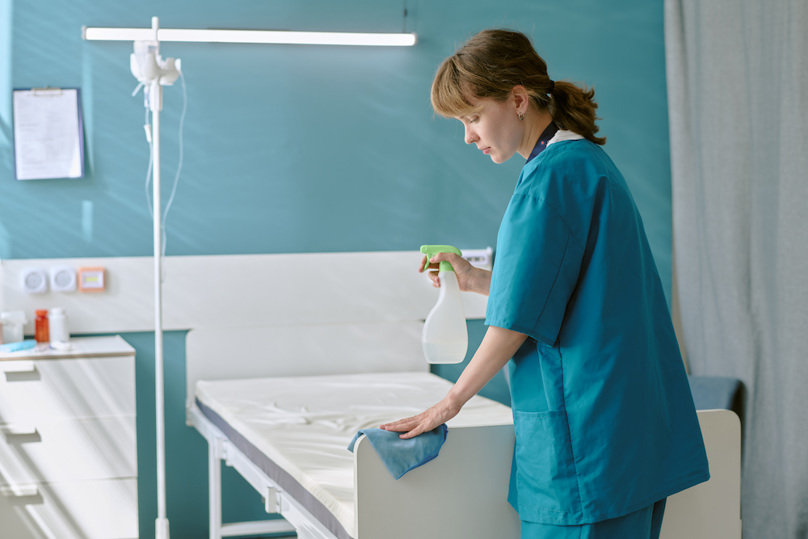
The durability of HYGEN microfibre mopping systems translates directly into operational savings. Facilities using the system have achieved a 17% reduction in daily cleans and a 27% reduction in terminal cleans.
Those numbers represent faster cleaning cycles, reduced labour time, and increased room turnover efficiency. When each mop pad cleans more effectively from the start, staff spend less time re-cleaning surfaces and managing pad changes. The flat mop design, paired with spray mops like the HYGEN PULSE system, eliminates the need for traditional buckets. The PULSE mop's onboard reservoir holds up to 0.6L of cleaning solution, enough to cover 79 square metres. It weighs just 2.8kg when fully loaded. The ergonomic trigger handle dispenses solution evenly, making wet mopping faster and easier across all floor types.
Spray mops are designed for efficient, light-duty cleaning of smaller areas, touch-up tasks, and spill cleanup without a mop bucket. Spray mops are ideal for quick-response floor cleaning throughout the day. For larger-scale operations, HYGEN charging buckets support a room-to-room wet mopping process that is proven to reduce cross-contamination. The spray mop approach of using less water and fewer chemicals pairs well with HYGEN microfibre pads. Facilities that combine a spray mop routine with HYGEN mop pads report easier, more efficient cleaning.
Quick-connect flat mop frames allow teams to adapt the mop to different areas. The trapezoidal frame shape improves access to corners and hard-to-reach spaces. A nylon swivel joint provides flexible manoeuvring across large areas and tight spots alike. These features make the system easier to operate for extended shifts.
For cleaning cart setups, HYGEN charging buckets hold 10 to 20 microfibre wet mop pads ready to go. Each pre-charged pad holds enough solution to clean up to 23 square metres. This room-to-room process eliminates cross-contamination from dirty bucket water and keeps fresh pads ready for each space. Charging buckets are designed to prevent oversaturation, so mop pads deliver consistent floor coverage every time.
HYGEN vs Standard Microfibre: A Clear Comparison
Standard Microfibre |
HYGEN™ Microfibre |
|
|
Wash lifecycle |
Typically 50–150 washes |
Up to 500 washes |
|
Bleach tolerance |
Low; fibres degrade quickly |
Up to 200 bleach washes per CDC guidelines |
|
Virus removal |
Varies; often untested |
99.9% of tested viruses with water alone |
|
Fibre integrity over time |
Breaks down after repeated laundering |
Maintains structure across full lifecycle |
|
Cleaning performance |
Declines well before replacement |
Consistent from first wash to last |
|
Daily cleaning reduction |
No proven data |
17% reduction in daily cleans |
|
Terminal clean reduction |
No proven data |
27% reduction in terminal cleans |
|
Construction |
Single or low-split fibres |
Premium 16-split nylon/polyester blend |
HYGEN microfibre is designed and constructed for the demands of commercial and healthcare environments.
The colour-coded system across blue, green, red, and yellow pads supports infection prevention protocols by reducing cross-contamination between zones. Blue for general cleaning. Red for bathrooms and dirty utility rooms. Green for food service and food preparation areas. Yellow for infectious isolation areas. Green mop pads and green cloths help food service teams maintain hygiene standards. The green colour code is instantly recognisable across large teams.
HYGEN microfibre is also available with RFID technology. Equipped with UHF RFID chips, the RFID-enabled mop pads and cloths support real-time tracking and optimal inventory management. The RFID range is durable up to 200 launderings while maintaining full cleaning performance.
For facilities that prefer single-use options, the HYGEN disposable microfibre range removes 99.99% of tested viruses with water alone. Disposable mop pads offer up to 2x more surface cleaning coverage. They are compatible with common disinfectants, including Quat, Chlorine Bleach, and Hydrogen Peroxide. The disposable range is ideal for high-risk or high-touch areas where laundering is not available.
A mop pad that lasts 500 washes replaces multiple short-lifespan alternatives. Fewer replacements mean less material waste heading to the landfill. It means fewer purchase orders and a lower total cost of ownership. Whether used for dry dust mopping or wet floor care, the same durable pad keeps performing.
Microfibre cleaning with HYGEN also reduces water and chemical consumption by up to 95% compared to traditional methods. Less water is used per cleaning. Fewer chemicals are required per cycle. This makes floor cleaning easier for facility budgets and the environment.
For organisations working toward ESG procurement standards, the durability of HYGEN microfibre is a sustainability driver. Long-lasting products that maintain performance reduce the environmental footprint of cleaning operations without sacrificing results.
Durability is not a secondary consideration. It is the foundation of a cleaning system that performs consistently, reduces operational costs, and supports infection prevention standards across healthcare facilities and commercial buildings.
HYGEN microfibre mopping systems from Rubbermaid Commercial deliver on that foundation. One mop pad. Up to 500 washes. Proven cleaning performance that lasts.
Explore our full range of HYGEN microfibre mopping systems today.