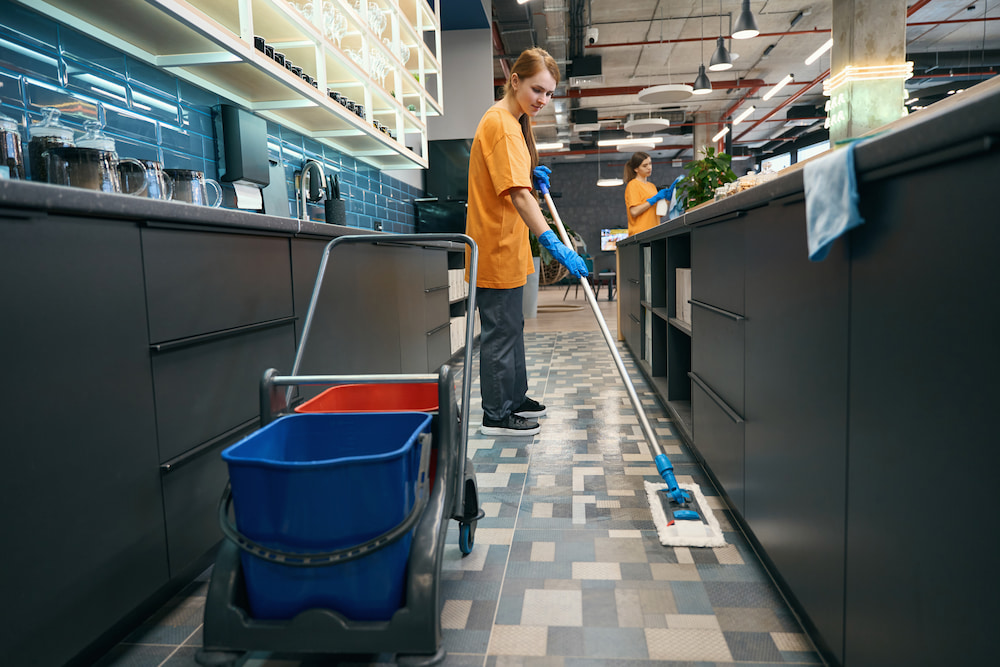
Hospitality cleaning staff face a daily grind that most guests never see. Between room turnovers, bathroom scrubdowns and lobby touch-ups, a single housekeeper may mop hundreds of square metres per shift. That repetitive floor cleaning puts serious strain on the body. Sore shoulders, stiff lower backs and fatigued wrists are common across the hospitality industry.
Speed pressure makes things worse. When checkout lines stack up, cleaning teams rush through common areas and guest rooms to meet tight deadlines. Under that pace, poor mop ergonomics turn small risks into real injuries.
So which mop actually protects your staff while still getting the job done fast? This article compares the flat mop vs string mop through two lenses: injury prevention and worker efficiency.
String mops (also called wet mops or cotton blend mops) have been standard cleaning equipment in hospitality for decades. The setup is simple: a mop head attached to a handle, paired with a bucket and wringer. But simplicity comes at a physical cost.
The operational strain of using a cotton string mop is significantly higher than most people realise. Staff must bend over the bucket, grip the heavy mop head and wring out excess water. This twisting motion loads the shoulders, wrists and lower back. The cycle repeats every few minutes across an entire shift. Regular maintenance mopping is one of the tasks most likely to cause fatigue and injury due to the large areas involved and the frequency of the task.
Heavy lifting is another hazard. A fully loaded bucket of water can weigh over 10 kilograms. Moving it from room to room or across large floors means constant lifting and dragging. Over time, these movements increase the risk of musculoskeletal injuries across the upper body.
String mops also spread dirty water back onto surfaces because the mop head and mop water can become heavily contaminated, causing staff to redistribute soil and microbes rather than remove them. According to a 1971 study on hospital sanitation, wet‑mop systems such as cotton string mops can become reservoirs of bacteria and may spread contamination across floors when used repeatedly without changing the water or the mop head. This forces staff to change the water frequently or accept a lower standard of cleanliness, either of which adds cleaning time or reduces hygiene across guest rooms, bathrooms and common areas. Cotton string mops can also leave lint on floors. This makes them look dirty even after a thorough cleaning.
Using a microfibre flat mop system can drastically reduce exposure to injury compared to traditional mops. The difference comes down to weight, body position and the elimination of repetitive wringing.
A microfibre flat mop with a damp pad weighs just over one kilogram. Compare that to a soaked cotton string mop that can weigh several kilograms before you even factor in the bucket. Less weight in the hands means less strain on the shoulders, arms and lower back over the course of a shift.
Body position plays a major role too. With a flat mop, the weight of the mop rests on the floor and the handle stays nearly vertical, close to the body. This is a far more ergonomic stance than the wide, extended arm movements needed to push and wring a string mop. Dust mopping with a flat mop keeps the body in a neutral posture that reduces fatigue over long cleaning sessions.
The biggest ergonomic gain comes from removing the wring cycle altogether. String mop systems force staff to repeatedly dunk, twist and squeeze heavy mop heads over a bucket. Flat mop systems skip that step entirely. Staff either use pre-charged microfibre pads or an on-board spray system. Pad changes take seconds with a simple hook-and-loop swap. There is no bending over a bucket, no wringing with force and no lifting heavy, waterlogged mop heads.
For hospitality teams who mop guest rooms, bathrooms, lobbies and restaurant floors across a full shift, these ergonomic improvements add up. Less physical strain means fewer injuries, less time off work and a team that can maintain consistent cleaning excellence day after day.
Consider the typical hospitality cleaning routine. A housekeeper may clean 12 to 16 rooms per shift. Each room requires mopping the bathroom floor and often a section of the main room. String mop systems force the worker to wring, lift and reposition a heavy bucket at every stop. Flat mop systems remove that cycle entirely.
With flat mops, staff use pre-charged microfibre pads or on-board spray systems. There is no bucket to drag. No wringing. No heavy lifting between rooms. The cleaning time per room drops because pad changes are fast and the mop glides over surfaces with less effort. This creates a safer, more productive workplace environment for housekeeping teams.
The hospitality industry also faces specific challenges around spills, food safety and guest-facing spaces. Flat mops with swivel heads reach under furniture and into corners that string mops struggle to access. Microfibre flat mops are made from synthetic materials that leave no lint behind, creating a streak-free finish that maintains the welcoming ambiance guests expect in hotels, restaurants and conference facilities.
Productivity in hospitality cleaning depends on how quickly staff can transition between tasks without sacrificing quality. Microfibre flat mop systems eliminate the slowest parts of traditional mopping: wringing, bucket refills and heavy lifting. The result is a faster, lighter and more hygienic cleaning workflow from room to room.
Flat mop systems like the HYGEN™ PULSE™ Microfibre Spray Mop deliver a controlled amount of cleaning solution directly onto the floor. The patented on-board reservoir holds enough solution to clean up to 79 square metres without a refill. This means floors dry faster, spills are managed with precision and bacteria are removed more effectively than with a string mop dragging dirty water across surfaces.
In hospitality, fast-drying floors are critical for guest satisfaction and safety. A microfibre flat mop delivers a dry time of about 7 minutes compared to 15 minutes for a string mop. Wet floors in lobbies and common areas create slip hazards. A mop that controls moisture output reduces that risk while creating a fresh, welcoming environment for guests. Flat mops also prevent moisture from damaging hardwood and laminate floors by using minimal water.
The HYGEN™ PULSE™ Spray Mop weighs only 2.59 kilograms when fully loaded. Compare that to a bucket and string mop system that can easily exceed 10 kilograms. Less weight means faster movement between rooms and less fatigue at the end of a shift.
The numbers tell the story. A cotton string mop takes about 45 minutes to clean a 300 square metre area. A microfibre flat mop covers the same space in approximately 25 minutes. That is a significant time saving when multiplied across a full day of room turnovers.
The ergonomic trigger handle dispenses three sprays of cleaner with each squeeze. Staff do not need to stop and return to a bucket. They can move through guest rooms, bathrooms, lobbies and restaurant floors in a continuous cleaning flow. This cuts cleaning time per room and supports faster turnaround during peak checkout periods.
Changing a microfibre mop pad takes seconds. The hook-and-loop attachment system on the HYGEN™ frame lets staff swap pads without bending, wringing or touching dirty surfaces. Each fresh pad delivers consistent cleaning performance with no cross-contamination between rooms.
For hospitality facilities that follow colour-coded cleaning procedures, Rubbermaid HYGEN™ Microfibre Pads are available in multiple colours. This helps teams assign specific pads to different spaces: one colour for bathrooms, another for guest-room floors, and another for food-preparation areas. This system supports food safety protocols and reduces the risk of contamination across different zones.
HYGEN™ Microfibre Mop Pads withstand up to 500 launderings. That long lifespan means fewer replacements and lower cleaning supplies costs over time. By comparison, a cotton string mop used daily on a site lasts about a month, with mop heads lasting only 15 to 30 washes before they need replacing.
A microfibre flat mop used daily can last approximately 6 months, with pads lasting 180 to 250 washes. Rubbermaid microfibre has been proven to remove 99.7% of tested viruses and bacteria, supporting the high hygiene standards guests expect in the hospitality industry.
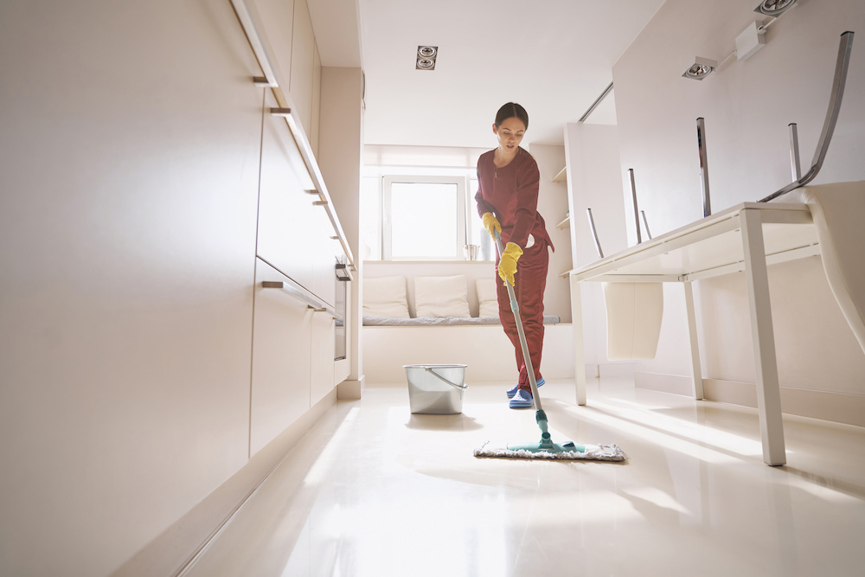
Musculoskeletal injuries from mopping are a well-documented risk in the cleaning industry. Shoulder strain, lower back pain and repetitive motion injuries can put staff out of action for weeks. In the hospitality industry, losing even one team member to injury creates a chain reaction: slower room turnovers, heavier workloads for remaining staff and potential dips in guest satisfaction.
Investing in ergonomic mop equipment is a direct form of workplace protection for your team. Flat mop systems produce lower muscle activity in the lower back and shoulder. They keep the mopping action closer to the body’s core. They reduce time spent in hazardous postures.
For hospitality businesses, this translates to fewer workers’ compensation claims, less staff turnover and a more sustainable cleaning operation. When your team can maintain high standards of cleanliness without putting their health at risk, the whole operation benefits.
Proper handling of cleaning equipment also ties into broader workplace safety. Staff who use ergonomic mop systems are less likely to develop the chronic pain that leads to absenteeism. When combined with appropriate personal protective equipment and the correct use of cleaning products and hazardous chemicals, flat mop systems contribute to a culture of safety and excellence across your facilities.
|
Factor |
String Mop (Wet Mop) |
Flat Microfibre Mop |
|
Ergonomic risk |
Higher strain from wringing, lifting and reaching |
Significantly lower movement risk and neutral body position |
|
Shoulder strain |
Asymmetrical, extended arm movements |
Handle stays vertical, close to body’s core |
|
Bucket required |
Yes. Heavy bucket needs constant lifting and repositioning |
No. On-board reservoir or pre-charged pads |
|
Cleaning time (300 sqm) |
~45 minutes |
~25 minutes |
|
Floor dry time |
~15 minutes |
~7 minutes |
|
Dirt removal |
35–40% of dirt. Often spreads bacteria |
Up to 75% of dirt. Removes 93% of viruses, 98% of bacteria |
|
Cross-contamination |
High risk. Dirty water returns to bucket and mop |
Low risk. Fresh pad for each room or zone |
|
Pad/head changes |
Slow. Requires wringing, detaching and replacing |
Fast. Hook-and-loop swap in seconds |
|
Weight (loaded) |
10+ kg with full bucket |
2.59 kg (PULSE mop fully loaded) |
|
Durability |
~1 month daily use. 15–30 washes per head |
~6 months daily use. Up to 500 launderings per pad |
|
Floor finish |
Can leave lint behind |
Streak-free, lint-free synthetic material |
Use this checklist to assess whether your current mop systems are holding back your cleaning team.
Staff report shoulder, back or wrist pain after mopping shifts.
Your team spends significant time wringing out mops and refilling or moving heavy buckets.
Floors stay wet for too long after mopping, creating slip hazards in guest areas.
You need to reduce cleaning time per room to meet turnaround targets.
Cross-contamination between rooms or zones is a concern for hygiene and food safety.
Your current mop heads need to be replaced frequently.
You want to maintain a higher standard of cleanliness across common areas, guest rooms and bathrooms.
Workplace safety audits have flagged manual handling risk from mopping equipment.
If you ticked three or more of these points, upgrading to a microfibre flat mop system could deliver measurable gains for your hospitality business.
The HYGEN™ PULSE™ Microfibre Spray Mop Kit is purpose-built for facilities that need speed, hygiene and ergonomic excellence. It removes the bucket from the equation, delivers a controlled cleaning solution through a lightweight spray system, and pairs with microfibre pads that remove dirt, dust and bacteria from all floor types.
Whether your team is cleaning polished concrete in a lobby, tile in a bathroom, timber floors in a restaurant or laminate in conference rooms, the PULSE™ mop handles every surface. The non-slip tip prevents the handle from sliding when placed against a wall. The nylon swivel joint allows flexible manoeuvring around furniture, doors and tight spaces.
Pair the PULSE™ system with Rubbermaid’s wider commercial cleaning range to build a complete hospitality regular cleaning setup that protects your staff and keeps guests coming back.