Facility managers and procurement teams are rethinking every product category against sustainability targets. Air care, once overlooked in waste reduction strategies, is now part of that conversation. Switching from traditional aerosol-based air freshener systems to passive systems can make a measurable difference to both performance and environmental impact. Unlike aerosols, passive systems require no propellants and produce no airborne chemicals.
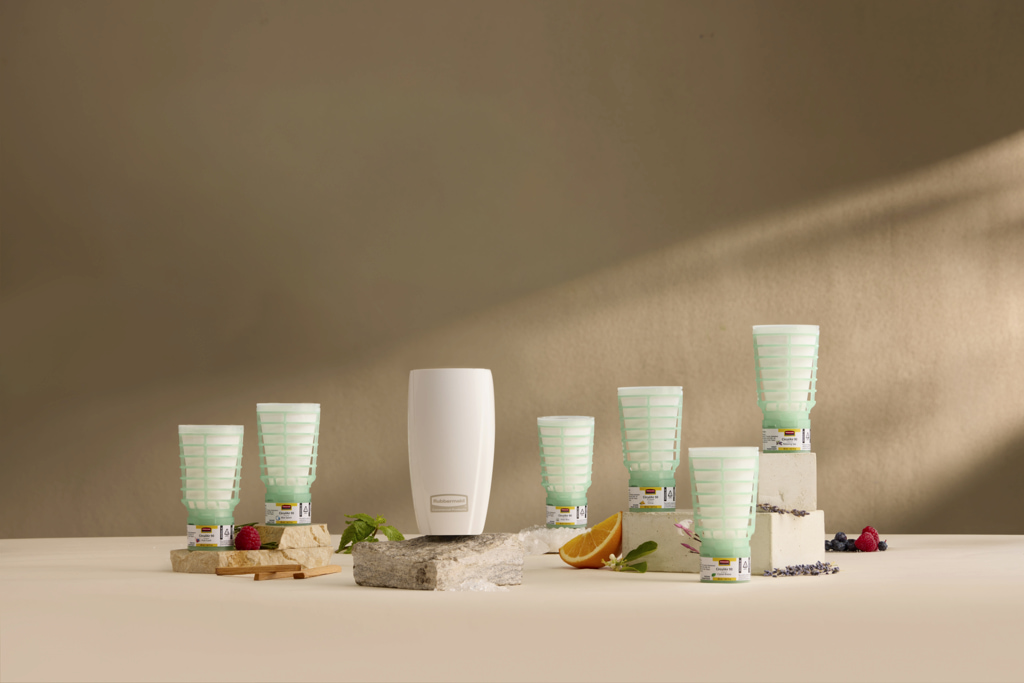
CirculAir 90™ Passive Air Care from Rubbermaid Commercial Products is a simple solution engineered to deliver reliable, maintenance-free fragrance for up to 90 days. It uses no batteries, no electricity, and no chemicals as propellants. The result is uninterrupted performance with verified recyclability, reducing environmental impact compared to its predecessor.
Battery-free, passive operation using natural airflow
Up to 90 days of continuous, reliable performance per refill
Made from a single, commonly recyclable material
Recycle-stream-ready refill with no disassembly required
8 fragrance options across Citrus, Fougere, Fruity, and Floral families
Dispenser available in White, Black, and Chrome
Procurement policies across Australia and New Zealand increasingly require measurable environmental credentials from suppliers. ESG reporting now accounts for Scope 3 emissions, which includes the products facilities buy, the energy used to produce them, and the waste they generate.
Every discarded battery and every multi-material refill sent to a landfill contribute to a facility's footprint. Companies managing washroom programs across multiple sites need products that perform without producing avoidable waste. Tender documents now ask for recyclability data. Procurement teams want products aligned with circular economy design guidelines, not linear take-make-dispose models.
Verified and assessed: The CirculAir 90™ passive refill has been independently validated through APCO's Packaging Recyclability Evaluation Portal (PREP) in Australia and New Zealand, providing a trusted layer of transparency for procurement and ESG teams.
Passive air care systems use natural airflow to release fragrance through controlled diffusion. There are no motors, fuel cells, or electronic components. This battery-free design removes the common failure points that produce odour gaps in traditional systems.
Fragrance output stays steady from day one through to day 90. There are no peaks and troughs. No batteries dying mid-cycle. No gaps in coverage between service visits. Customers and visitors experience a fresh, consistent environment free of lingering odours every time they enter the bathroom or washroom.
The servicing model is simpler, too. Staff swap the passive refill roughly once per quarter and move on. There is no need to troubleshoot mechanical failures or manage multiple component types. For multi-site operations, this simplicity helps save time and money. Stock management drops to a single SKU per fragrance rather than refills, batteries plus fuel cells.
When batteries fail in traditional systems, fragrance stops. Staff may not notice immediately, creating odour gaps that affect visitor experience. Half the battle with conventional air freshener units is keeping them powered and functioning consistently.
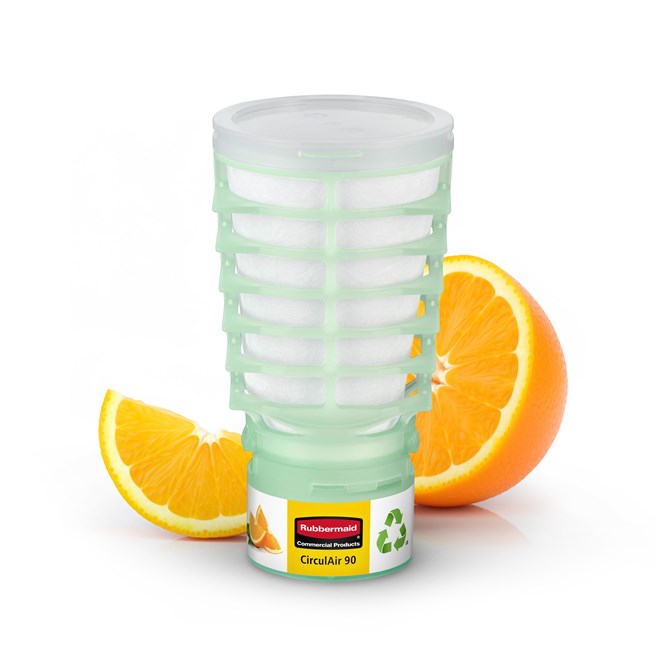
CirculAir 90™ removes this entirely. The system operates via passive diffusion, with no electrical components. No electricity, no fuel cells, no mechanical parts. A single refill change every 90 days replaces what would otherwise require multiple battery checks over the same period.
Switching to a battery-free design also removes a difficult waste stream. Batteries require special disposal pathways in many Australian jurisdictions. Eliminating them from the air care program reduces both waste volume and administrative effort for cleaning teams.
Each CirculAir 90™ refill is made from one commonly recyclable material. It goes directly into the recycling stream as a single piece. The recycle-stream-ready design means no dismantling or separation is needed before disposal.
Many conventional air freshener refills combine plastics, metals, bottle components, and other materials in ways that make recycling impractical. The cost of dismantling multi-component packaging means most end up in general waste rather than being recycled.
The CirculAir 90™ refill has been independently validated through APCO's PREP, which verifies that it meets key recycling system requirements and design guidelines recognised across Australia and New Zealand. This single-material construction is a deliberate engineering choice to support circular washroom programs.
Disclaimer: Recyclability assessed through APCO's PREP tool. Actual recycling outcomes depend on local collection infrastructure and processing capabilities.
An ISO-compliant Life Cycle Assessment (LCA) conducted by South Pole compared CirculAir 90™ with its predecessor, TCell. The findings showed reduced environmental impact across all 16 key categories assessed:
36% less metal and mineral resources used
11% fewer greenhouse gas emissions across the product lifecycle
The LCA followed ISO 14040 and 14044 standards and was independently peer-reviewed.
Globally, the transition is projected to save approximately 92.5 metric tonnes of CO₂ equivalent per year. That also includes 4.5 metric tonnes of metal and 3 metric tonnes of plastic. To put those CO₂ savings in context, they are equivalent to roughly 49 round-trip transport flights between New York and London, or the carbon absorbed by thousands of plants over a year.
The passive air care refill is also formulated without VOC propellants or harsh chemicals. This supports indoor air quality goals in healthcare, aged care, and hospitality settings where green building standards and the Clean Air Act are priorities.
|
Feature |
CirculAir 90™ (Passive) |
Traditional Aerosol Systems |
|
Power source |
None (battery-free) |
Batteries or fuel cells |
|
Refill lifespan |
Up to 90 days |
Typically 30–60 days |
|
Servicing cadence |
Quarterly refill swap |
Monthly battery + refill checks |
|
Fragrance consistency |
Steady output via diffusion |
Peaks and troughs between sprays |
|
Refill material |
Single material, recyclable |
Multi-material, often non-recyclable |
|
Waste streams |
1 (recycle-stream-ready refill) |
2–3 (refill + batteries + packaging) |
|
VOC propellants |
None |
Common in aerosol formats |
|
Indoor air quality impact |
No chemicals released |
Potential VOC concerns |
Placement matters. Each CirculAir 90™ dispenser covers mid-size washrooms with 3 to 4 fixtures, up to approximately 6,000 cubic feet. Position dispensers where natural airflow can carry the fragrance through the space. Avoid corners or areas behind doors with poor air circulation.
Match fragrance to traffic. The range spans seven fragrances with intensity levels from mild to intense. High-traffic bathroom spaces in hospitality or retail may benefit from a stronger option. Quieter office washrooms may suit a milder scent. Having 8 air care options means each location across commercial environments can be matched to its needs.
Align with your service cadence. A 90-day refill life aligns naturally with quarterly service schedules. Adding a refill swap to existing restocking routines is a minor addition to current workflows. This helps cleaning teams save time on air care so they can focus on higher-priority tasks.
Use existing hardware. CirculAir 90™ refills are compatible with existing Rubbermaid Commercial passive air care dispensers. Each dispenser features a sleek wall-mounted design that suits any commercial environment. Upgrading does not require new hardware.
Each CirculAir 90™ refill delivers continuous fragrance for up to 90 days. That is reliable air care performance from a single refill, with no batteries or power source required.
There are 8 options spanning Citrus, Fougere, Fruity, and Floral families with intensity levels from mild to intense.
Yes. The refill is made from a single, commonly recyclable material and has been independently validated through APCO's PREP. It can be placed into the recycle stream without disassembly. Actual recycling outcomes depend on local infrastructure.
No. The system is completely battery-free and operates through passive diffusion using natural airflow. There are no motors, electricity requirements, or fuel cells.
Each dispenser covers mid-size washrooms with 3 to 4 fixtures, up to approximately 6,000 cubic feet.
Yes. CirculAir 90™ is engineered to deliver reliable, maintenance-free fragrance across commercial environments, including healthcare, hospitality, aged care, education, and office facilities.
Battery-free operation, 90-day refill life, a single commonly recyclable material, and verified LCA data give procurement and sustainability teams the confidence to act. Explore our full range of CirculAir 90™ Passive Air Care Refills.